
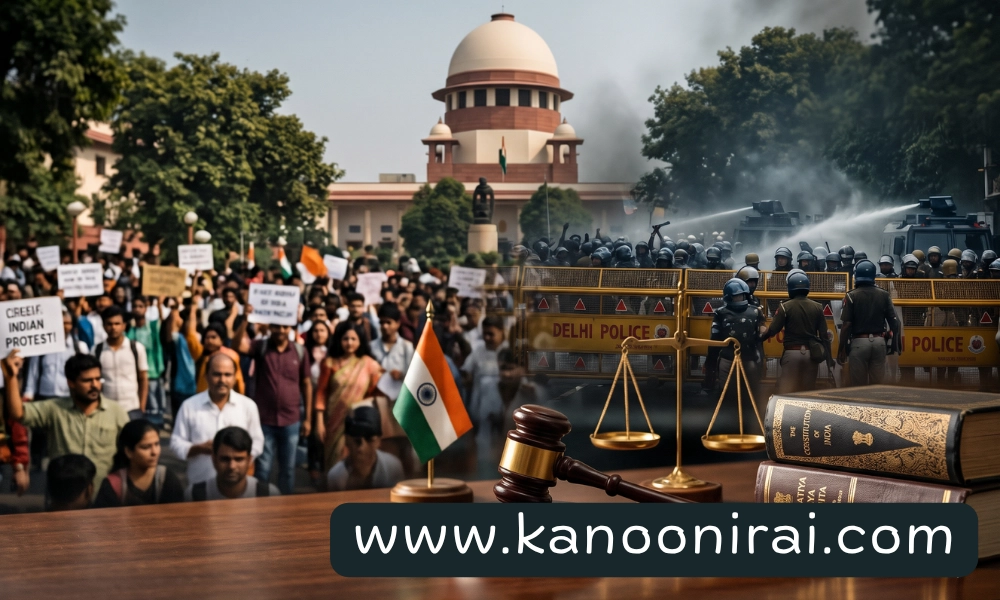
The right to peaceful assembly is the lifeblood of any vibrant democracy, guaranteed under Article 19(1)(b) of the Constitution of India. Yet, this right is not absolute. It is tethered to the "reasonable restrictions" outlined in Article 19(3) in the interest of the sovereignty, integrity, and public order of the nation.
When a peaceful gathering morphs into a disruptive mob, the law strips away its constitutional protection, reclassifying it as an "unlawful assembly." Today, as our criminal justice system transitions from the colonial-era Indian Penal Code (IPC) to the newly implemented Bharatiya Nyaya Sanhita, 2023 (BNS), it is imperative to dissect the anatomy of an unlawful assembly, the principle of joint liability, and how our constitutional courts are currently balancing competing rights in the wake of the 2026 Delhi protests.
Decoding Unlawful Assembly: From the IPC to the BNS
Historically, Section 141 of the IPC defined the offense of unlawful assembly. Under the new BNS, this exact jurisprudence has been absorbed and codified under Section 189 BNS.
A gathering of five or more persons is not inherently illegal. A crowd at a marketplace or a peaceful vigil is perfectly lawful. However, the assembly crosses the legal Rubicon and becomes unlawful when the members share a common object to commit any of the following five illegal acts:
Intimidate the Government: Using or showing criminal force to overawe the Central or State Government, Parliament, or any public servant.
Resist Legal Processes: Obstructing the execution of any law or legal process.
Commit an Offense: Gathering with the shared intent to commit mischief, criminal trespass, or any other offense.
Forceful Dispossession: Using criminal force to take possession of property or deprive someone of their rightful property enjoyment.
Compel Illegal Acts: Forcing someone to do what they are not legally bound to do, or preventing them from doing what they are legally entitled to do.
The penal consequences for merely being a member of such an assembly—previously up to six months of imprisonment under Section 143 IPC—are now governed by Section 189(2) BNS.
The Aggravating Factor: Armed Assemblies
The law takes a remarkably stern view of individuals who join an unlawful assembly armed with weapons. Previously addressed by Section 144 IPC, this aggravated offense is now housed under Section 189(4) BNS.
If a person joins an unlawful assembly armed with a deadly weapon—or an object that, when used offensively, is likely to cause death—the punishment escalates to a potential two years of imprisonment, a fine, or both. The legislative intent here is clear: the mere presence of deadly weapons in a volatile, emotionally charged crowd exponentially increases the threat to public tranquility. This offense remains cognizable, bailable, and triable by any Magistrate. Furthermore, refusing to disperse after a lawful command from the authorities—previously Section 145 IPC—now invites a similar two-year penalty under Section 189(3) BNS.
To preemptively prevent such gatherings, executive magistrates utilize prohibitory orders. While lawyers historically refer to this as a "Section 144 order" under the old Code of Criminal Procedure (CrPC), the corresponding provision under the new Bharatiya Nagarik Suraksha Sanhita (BNSS) is Section 163 BNSS, which empowers magistrates to issue urgent directives to prevent danger to human life, health, or a disturbance of the public tranquility.
The Draconian Edge: The Principle of Joint Liability
Perhaps the most potent weapon in the State's prosecutorial arsenal regarding crowd violence is the principle of joint and constructive liability. Governed formerly by Section 149 IPC and now by Section 190 BNS. This principle dictates that if any member of an unlawful assembly commits an offense in prosecution of the common object, every person who is a member of that assembly at the time is equally guilty of that offense. As explored in our detailed analysis of Satbir Singh and Others v. State of Uttar Pradesh, the Supreme Court has consistently held that the specific overt act of an individual is less material than their active participation in an assembly with a shared illegal objective.
You do not need to wield the stick or light the match to be charged with the resulting crime. The law imposes strict vicarious liability based on the shared objective.
The Evidentiary Nuance: Mere Presence vs. Overt Acts
Despite the harshness of joint liability, the judiciary acts as a vital safety valve to prevent the wrongful conviction of innocent bystanders. A fundamental tenet of our jurisprudence is that mere presence at the scene does not automatically make someone a member of an unlawful assembly.
As established in the landmark case of Baladin v. State of Uttar Pradesh (1956), a person caught in the crossfire of a riot while walking home is not liable. The prosecution must prove that the individual possessed the "common object" and intentionally joined or remained in the assembly after becoming aware of its unlawful nature. In Masalti v. State of U.P. (1964), and later reaffirmed in Om Prakash v. State of Haryana (2014), the Supreme Court clarified that while an individual does not need to commit the principal crime, there must be evidence of some overt act or a deliberate omission of a legal duty that aligns with the assembly's illegal objective.
Contemporary Application: The 2026 Delhi Protests
The theoretical conflict between the right to assemble and unlawful disruption has played out dramatically in the recent 2026 protests in New Delhi. Seeking the resignation of Chief Election Commissioner (CEC) Gyanesh Kumar and the scrapping of the SIR, protestors affiliated with various youth and political organizations attempted to converge on Jantar Mantar and march toward Parliament.
The State’s response was unprecedented. Authorities imposed citywide lockdowns, invoked prohibitory orders, suspended internet services, and detained an estimated 7,000 individuals to prevent the gathering from coalescing. Protestors argued that their fundamental right to speech and peaceful assembly—which includes the right to internet access as ruled in 2020—was being unconstitutionally stifled by the police clampdown.
However, the resulting disruptions brought the matter sharply before the Supreme Court in November 2026. Hearing petitions regarding both the alleged illegal detentions and the severe economic impact on local businesses (such as the Kirana Committee Delhi), a bench led by Chief Justice of India (CJI) Surya Kant laid down crucial observations regarding the spatial and temporal limits of the right to protest.
According to reports from The Times of India and The New Indian Express, the Hon'ble CJI unequivocally stated, "You can't occupy a site at all times. Where will farmers, journalists, etc., go? Everyone has the right to protest. Designated time must be given for designated period". The Court emphasized that while the right to protest is constitutionally recognized, it must be balanced against competing fundamental rights—specifically, the right to trade and livelihood under Articles 19(1)(g) and 21.
Addressing the march toward the legislature, the Supreme Court noted that historically designated protest sites like Ramlila Maidan cannot be occupied indefinitely. Highlighting the plight of hawkers and daily-wage workers in the densely populated areas, the Supreme Court stressed that the livelihood of ordinary citizens cannot be indefinitely paralyzed by prolonged agitations. The hearing came after the Centre de-notified Jantar Mantar as a designated protest site, identifying alternative venues like Burari Ground instead.
This ongoing litigation perfectly encapsulates the delicate tightrope walk of constitutional law. An assembly formed to protest government action is the hallmark of liberty. But when that assembly violates legal boundaries, paralyzes a city's economy, or marches unpermitted into sovereign institutional spaces, the legal machinery shifts.
The transition from the IPC and CrPC to the BNS and BNSS may have changed the section numbers, but the core philosophy remains untouched. If you are navigating the new procedural laws, you can also read our guide on what to do when a negative final report is submitted under the BNSS and CrPC.