
Can a Minor Be a Partner in a Firm? In a partnership firm a minor parter has been introduced on the contribution of his father. His father contributed some fund in the partnership firm and desired to introduce his minor son as parter with 25% share in profit and loss. Since his father was investor in firm and his interest needs to be protected then he has made partner. A partnership deed was duly registered. After the registration of firm it has been functioning well since 2023.
In 2025 one more partner was introduced and new deed was represented for registration of firm. After the reshuffling in firm, shareholders right in profit and loss was also decided. according to the fresh deed I have 60% share in profit & loss and remaining two are sharing 40% share with equal liabilities.
The firm took part in the tender invited by the Airport Authority of India and secure a technical bid. When the bid was considered for final allotment, the AAI has rejected our bid on the basis that partnership firm is invalid. We represented the AAI and sought some more time to remove the illegality. How to remove this illegality in the partnership firm?
Asked from: Maharashtra
As per the partnership deed executed for the formation of your firm, the minor was shown not merely as a person admitted to the benefits of the partnership, but as a partner having a 20% share in the profits as well as losses of the firm. This provision creates a serious legal defect in the constitution of the firm.
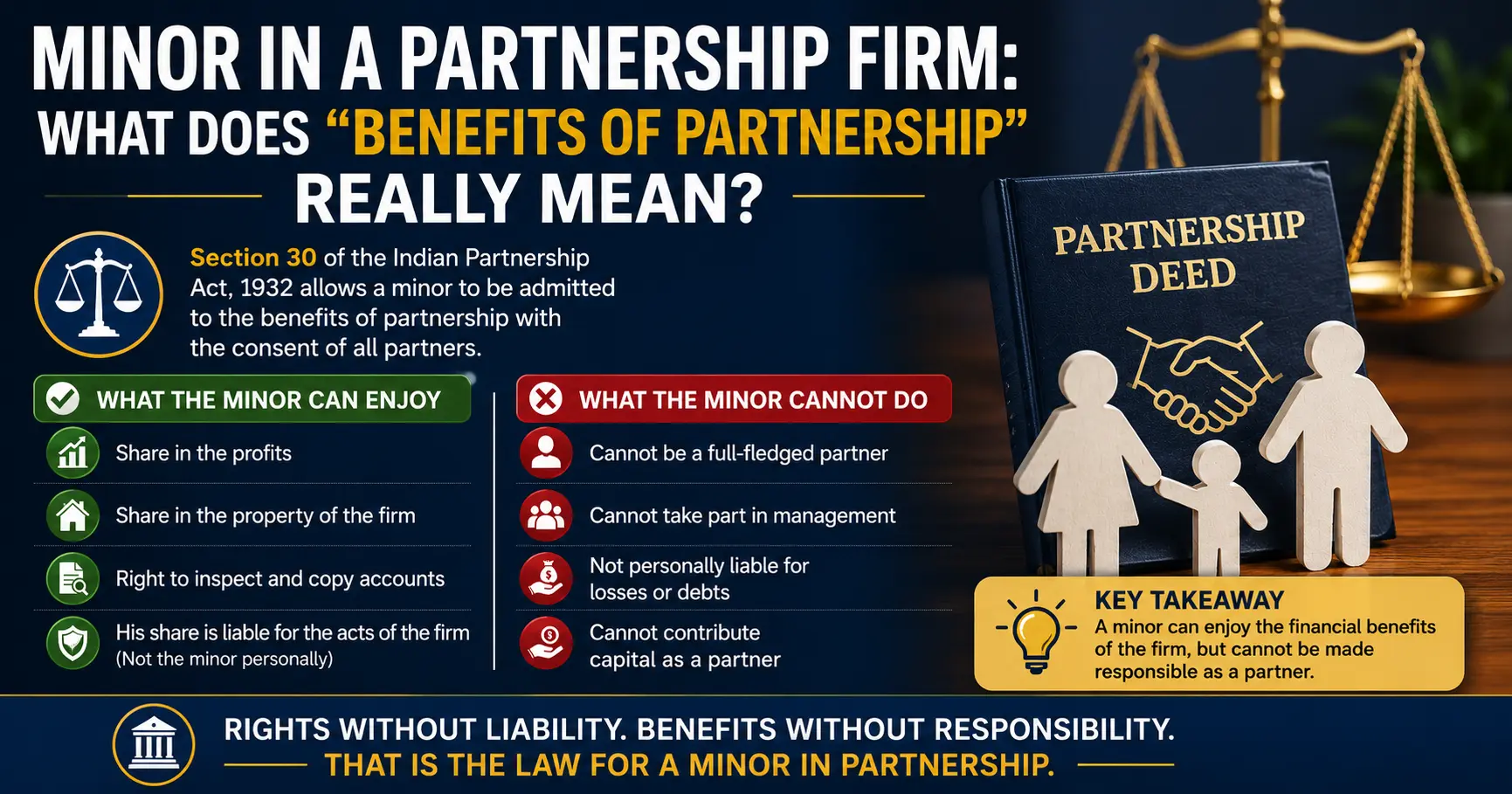
Section 30 of the Indian Partnership Act, 1932 specifically provides that a minor cannot be a partner in a firm. However, with the consent of all the existing partners, a minor may be admitted only to the benefits of partnership. The minor may be given an agreed share in the property and profits of the firm, but he cannot be treated as a full-fledged partner or be made personally liable for the acts and losses of the firm.
Therefore, if the partnership deed expressly describes the minor as a partner and makes him responsible for the losses of the firm in the same manner as the adult partner, the deed does not conform to Section 30 of the Partnership Act. The defect becomes more serious where the minor has been given the status and responsibilities of an adult partner and has been made liable for the firm’s losses.
The Supreme Court in Commissioner of Income Tax, Bombay v. Dwarkadas Khetan & Co., AIR 1961 SC 680, held that a minor cannot enter into a contract of partnership and cannot be made a full-fledged partner. A partnership deed which expressly makes a minor a full partner is not a valid partnership deed for the purpose of registration. The defect cannot simply be cured by treating the minor as if he had originally been admitted only to the benefits of partnership.
In your case, the difficulty is even more significant because, from the beginning, the firm consisted of only two persons, one of whom was a minor. Since a minor cannot be a partner, there was, on the face of the deed, only one person capable of entering into the partnership contract. This raises a fundamental objection to the constitution of the firm itself.
For this reason, merely executing a subsequent clarification deed or rectification deed and submitting it to the Registrar of Firms may not satisfactorily cure the original defect. The Supreme Court’s decision in Dwarkadas Khetan makes it clear that an instrument which is fundamentally defective because it constitutes a minor as a full partner cannot simply be converted into a valid partnership deed by giving it a different interpretation.
It is important, however, to distinguish between a minor being made a full partner and a minor being admitted to the benefits of partnership. The latter is expressly permitted by Section 30. A minor may receive an agreed share in the property and profits of the firm, and his share may be affected by the acts of the firm, but he is not personally liable for those acts.
Accordingly, if the existing deed treats the minor as a full partner and imposes upon him the liabilities of an adult partner, the safer legal course would be to avoid relying upon a mere rectification deed and to consider constitution and registration of a fresh partnership firm in accordance with the Partnership Act, 1932.
The fresh partnership deed should clearly comply with Section 30. The adult partners should constitute the partnership, while the minor, if he is to be associated with the business, should be admitted only to the benefits of the partnership with the consent of all the partners. The deed should not confer upon the minor the status of a partner or impose personal liability upon him for the debts, obligations or losses of the firm.
Therefore, in the circumstances stated by you, obtaining a fresh registration, after properly restructuring the constitution of the firm and preparing a partnership deed compliant with Section 30, would be the more legally appropriate course rather than attempting to cure the original defect merely through a clarification or rectification deed.
A minor may be admitted only to the benefits of partnership
In simple terms, the minor can receive the benefit of the business, but he cannot be made responsible as a partner. He can have a share in profits and property, but he cannot be made personally liable for the firm’s debts and losses or be treated as an adult partner in the management of the firm.
However, giving the minor a share in the profits does not make him a partner. He continues to remain a minor who has only been admitted to the benefits of the partnership. He cannot be made personally responsible for the debts or liabilities of the firm in the same manner as an adult partner.
This distinction is particularly important in the case of losses. A minor cannot be made personally liable to contribute money towards the losses of the firm. His interest in the property of the firm may, of course, be affected because of the losses suffered by the firm, but the minor’s personal property cannot be used to recover the firm’s debts merely because he has been admitted to its benefits.
The minor is also entitled to inspect and take copies of the accounts of the firm. This right is given so that he can know what is happening to his financial interest in the firm. At the same time, he does not acquire the ordinary rights of an adult partner merely because he has a share in the profits.
Therefore, the expression “admitted to the benefits of partnership” essentially means that the minor can enjoy the financial benefits of the business without becoming a partner and without undertaking the personal liabilities of a partner.